
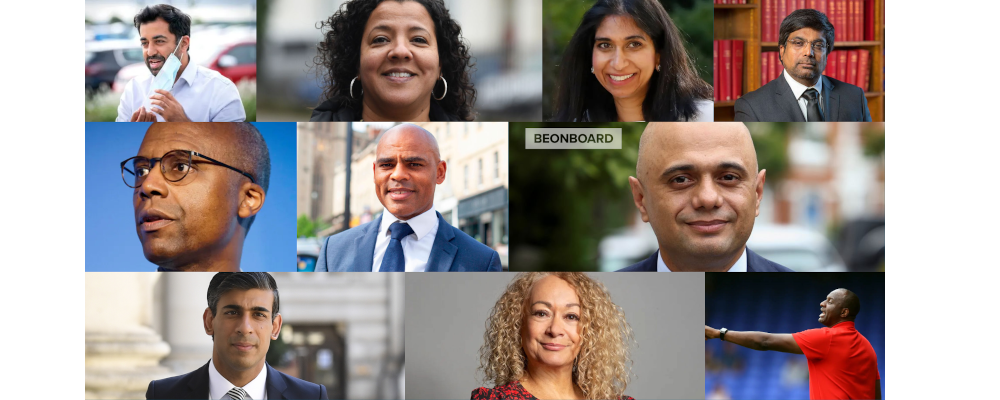
With an upsurge of BAME representation in top leadership positions over the last year, Operation Black Vote’s study of race and leadership in the UK is both hopeful and troubling. But what’s the story in Bristol and the South West, asks Meesha Cru-Hall.

As it would only be right to start with an introduction – my name is Meesha Cru-Hall, the latest proud member of BeOnBoard, and here I’m intending to share my thoughts on the Colour of Power …
The 24th of September 2017 was the official launch of the ‘Colour of Power’ (CoP) – a necessary study of where race and power lie within Britain. Operation Black Vote partnered with Green Park and The Guardian to bring it to the nation’s attention. What the study uncovered was deeply troubling. 3.4% of the 1,049 individuals in top leadership positions in this country held Black, Asian and minority ethnic identities. That’s a total of 36. The fact that 97% of Britain’s most powerful elite was White revealed that despite decades of anti-discrimination laws – the scales were still massively tilted.
Turbo-charge progress
Operation Black Vote reported relatively slow progress with only 5 new leaders of colour a year being added to this list. However, over the last 12 months or so this progress has “turbo-charged” – with an increase of 23 Leaders of Colour (LoC) outstripping all previous years by 5 times; Joanne Anderson also adds to the celebrations as the first woman *and* the first Black woman to become mayor of Liverpool. So, fast-forwarding to the most recent CoP Report in 2021, it’s fair to say that following the murder of George Floyd, the work of the Black Lives Matter (BLM) movement has helped to disrupt this leadership status quo for good. Simply put, from our civic institutions, business and society they demanded urgent and immediate change. In particular for a fairer more representative workforce and leadership team that not only reflected but also fully embraced Black and Brown talent at all levels.
This study of leadership allows us to see it, which allows us to analyse it, to know where the change needs to be made and to keep the momentum going. From politics to media, law to consultancy, the armed forces and many other “key facets” of our society – Operation Black Vote have looked at its leadership. Those leaders being dominatingly White and male which is unrepresentative of the vibrantly diverse society that we live in. I think the growing success of this year’s CoP study should be a critically important signal to the vast number of BLM protestors that their campaigning efforts were not in vain. You began the conversation.
Putting down roots
To better understand these systemic changes in society and business we recently caught up with Lord Simon Woolley, the director behind Operation Black Vote. He reminisced on personal experiences watching as Black colleagues stunned their CEOs just merely from relaying their ordeals. Significantly, causing these same CEOs to take notice of their Boards and senior leaders, positions which are unfairly rigged against Black and Brown people.
Since 2017, the number of Black, Asian and minority ethnic individuals in Britain’s top leadership positions have doubled from 36 to 73. When speaking with Simon and Mayowa Ayodele (another member of Operation Black Vote) they highlighted that this is not intended to be static. Emphasising that the CoP is organic and the metaphorical ‘putting down of roots’ – it is the gift that keeps on giving. It is now my wish to take a sample of this tree, plant it in Bristol and watch it grow.
So, pivoting to the South-Western region, we can say that politically we are in good shape. Marvin Rees is our mayor and is joined by two additional Bristolian Leaders of Colour, Sajid Javid and Nishan Canagarajah, all featuring on the CoP list and a beautiful variety of representation within cabinet members (6 Conservatives), ministers (7 Conservatives) and council leaders (11 from the Labour Party). However, we could still do with seeing improvements in certain areas e.g. I personally looked at the top ten companies in the Bristol area, the University of Bristol (UoB) ranked #2, Airbus ranked #4 and the NHS ranked #6. These are examples of education, business and healthcare – coinciding with the categories featured in Operation Black Vote’s research. When looking at their Boards, the number of Black, Asian and minority ethnic members were relatively low: 5/19 for UoB, 1/12 for Airbus and 1/17 for the NHS.
I think those figures speak for themselves.
It is a tale of two cities
Simon put it like this: “There is a veneer that says multicultural Bristol because you are looking at the whole but you scratch the surface and it is a tale of two cities.” Going on to explain that: “The Bristol region, outside of London, is one of the richest in the country. All the big companies are there – Airbus, Lloyds Bank, Channel 4 … everyone is beating the path to Bristol, but are Black people having a look-in? Not so sure.”
Identifying Bristol’s CoP will lay the stark contrast between our tale of two cities out bare – from wealthy parts such as Clifton to poorer parts where Black and Brown individuals live. Operation Black Vote has given us the blueprint, and while it is great that our political leader is in that national conversation; there are undoubted benefits in having our own leadership study to know what’s going on on a more local and personal level.
This is merely a mini snapshot and if you are reading this, please feel free to construct your own CoP study – it needn’t be complex, just an overview of areas in society that matter to you – the power you gain from just a little bit of insight can be as surprising as it is fulfilling. Once you have your own snapshot maybe you’ll run with it like I intend to – at the top of my list is a conversation with Mr. Rees in an endeavour to plant our sapling within the heart of Bristol, because as we know – if it is measured, it can change.