
November 22 came and went without many of us realising it was Equal Pay Day in the UK, the day women effectively stop earning for the rest of the year. What’s notable is that the day passed by in an unusually quiet manner, without headlines or social media buzz.
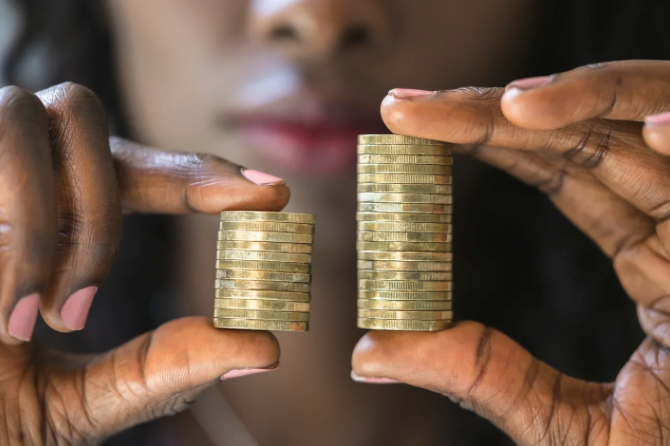
Perhaps the silence is because of the slow progress on the gender pay gap this year. Equal Pay Day moved from November 20 in 2024 to November 22 in 2025. Only two days later, which means women now work free for 39 days – nearly seven full weeks until the end of the year.
The picture only gets worse when you add ethnicity. UK-born Black employees earn 5.6% less than their white colleagues. Across gender, the pay gap hits hardest for Mixed White and Black Caribbean workers, who earn 18.5% less than White British workers, and Bangladeshi workers, who earn 17.5% less. For women from these communities, the penalties compound: Bangladeshi women face a 28.4% pay gap, Pakistani women 25.9%, and Mixed White and Black Caribbean women 25%. Black, minority ethnic, and disabled women consistently face the steepest pay disparities. Put differently, with a 28.4% gap, Bangladeshi women work more than three months for free. This is The Double Tax.
One of us, Anna Gifty, defines the gap that women of colour experience as ‘The Double Tax’, which is the compounded cost of racism and sexism. In the book I wrote this year, I share that failing to address pay disparities among women, and women of colour by extension, shows up in the lives of women and the communities they ultimately support. This is evident when you look beyond the formal economy and sectors dominated by men.
For women working in cash-in-hand care work, home-based services, and caregiving, the coordination that keeps families and communities functioning is grossly undervalued or not valued at all. Women of colour disproportionately face this reality. For example, people who provide intensive caregiving, which is defined as more than 20 hours per week, are disproportionately Black African or Asian. In fact, globally, the United Nations finds that by not paying women in caregiving roles a fair wage, countries are losing outon economic growth. In the UK alone, caregiving is worth nearly 48 billion dollars per year, which is equivalent to approximately 2 percent of the country’s GDP. When economic inequality becomes so normalised that the day marking women’s mass economic disenfranchisement passes without notice, we’ve accepted the unacceptable. Which begs the question: What if women just stopped working?
On October 24, 1975, 90% of Icelandic women stopped working across the informal and formal sectors. This dual withdrawal revealed the truth: without women’s underpaid and unpaid labour, Icelandic society came to a halt. Schools closed, factories shut, and men panic-bought sausages to make packed lunches. Within a year, Iceland passed equal rights legislation, becoming the world’s most gender-equal country for 16 consecutive years.
Given that women subsidise the UK economy twice over. First, through underpaid labour with 39 days of free labour from November 22 onwards, concentrated in sectors like healthcare, education, and care work, where wages remain stubbornly low. Second, through £184.3 billion in unpaid care work annually. It should be no surprise that in the absence of working women, especially women of colour, the economy would collapse.
The lesson? You can’t fix the pay gap without addressing unpaid work. You can’t value care work without raising wages in the care sector. They’re the same system of extraction, women doing essential work, being paid less or not at all. An economy that fails the most vulnerable among us ultimately is one that leaves many of us behind. That’s why we all have to join The Day That Women Stop on November 27.
Zara Nanu MBE is Founder and CEO of WorkVue and Professor in Practice at University of Bristol Business School. Anna Gifty Opoku-Agyeman is an economist and author of “The Double Tax: How Women of Colour are Overcharged and Underpaid”